
The Real Cost of Ignoring a Check Engine Light in Las Vegas
If you drive in Las Vegas long enough, you already know the feeling. You are cruising down the 215, the sun is beating down on the dashboard, and suddenly that little amber engine icon flicks on. For a lot of drivers, the first instinct is to shrug it off. The car still runs fine, so it cannot be that serious, right? Unfortunately, that assumption is exactly how a fifty dollar fix turns into a fifteen hundred dollar repair bill. As a mobile mechanic serving drivers across Las Vegas, we see this pattern play out constantly, and the heat here makes it worse than almost anywhere else in the country.
What The Check Engine Light Actually Means
The check engine light is connected to your vehicle’s onboard diagnostic system, often called OBD2. This system constantly monitors dozens of sensors and processes throughout your engine and emissions system. When something falls outside of its expected range, even slightly, the computer stores a trouble code and lights up that dashboard icon. It is a warning system, not a diagnosis. The light itself cannot tell you whether the problem is a loose gas cap or a failing catalytic converter. That is why a proper scan and inspection matters so much before you decide the issue is minor.
Some of the most common triggers we find during mobile diagnostics in Las Vegas include a faulty oxygen sensor, a worn out mass airflow sensor, ignition coil problems, a failing catalytic converter, or something as simple as a gas cap that was not tightened all the way. On the surface, these all look identical to the driver. The dashboard shows the same light no matter which one it is. That is exactly why guessing is such a risky move.
Why Nevada Heat Changes The Equation
Las Vegas summers push engine bays to temperatures that most vehicles were never really designed to handle for extended periods. When you already have a small issue, like a sensor reading slightly out of range or a vacuum leak that is barely noticeable, extreme heat accelerates the damage. Rubber hoses dry out and crack faster. Plastic components warp. Fluids break down more quickly. A misfire that might sit quietly for months in a cooler climate can snowball into a damaged catalytic converter within weeks under Nevada conditions.
We have picked up plenty of service calls where a driver ignored the light for a month or two because the car “still drove fine.” By the time we arrived, what started as a forty dollar oxygen sensor had turned into a full catalytic converter replacement, a repair that can run well over a thousand dollars depending on the vehicle. The heat did not create the original problem, but it absolutely sped up the timeline from minor issue to major expense.
The Domino Effect Inside Your Engine
Cars are systems of interconnected parts, and a small problem rarely stays small. A failing oxygen sensor throws off your fuel mixture. A fuel mixture that runs too rich or too lean puts extra strain on the catalytic converter. That extra strain generates more heat inside a component that is already sensitive to temperature. Add in the ambient heat of a Las Vegas summer, and you have a recipe for a part that was fine a month ago becoming a five figure job on a luxury vehicle, or at minimum a very expensive afternoon for anyone else.
The same logic applies to something like a failing ignition coil. Left alone, a single misfiring cylinder can send unburned fuel into your exhaust system, again overheating your catalytic converter and sometimes damaging your engine’s internal components. What began as a code you could have addressed with one part and an hour of labor becomes a much larger job involving multiple systems.
Why Waiting Rarely Saves You Money
There is a common belief that if the car still drives normally, there is no rush. We understand the instinct, especially when life is busy and a repair feels like an inconvenience you would rather push to next month. But the numbers rarely work in your favor. A diagnostic scan and a straightforward sensor replacement is almost always cheaper than the compounding damage that follows weeks of ignoring the light. Fuel efficiency also drops when your engine is not running the way it should, so you are often paying more at the pump every single day you wait, on top of the eventual repair cost.
There is also the safety angle to consider. Some of the codes that trigger a check engine light relate to systems that affect how your vehicle performs under load, like on the Las Vegas freeways where drivers regularly merge at high speed. A hesitating engine or unexpected stall is a bigger risk on the 15 or the 215 than it would be on a quiet side street.
What To Do When The Light Comes On
The first step is simply not to panic, but also not to ignore it. If the light is flashing rather than staying solid, that usually indicates a more urgent issue, such as an active misfire, and you should stop driving as soon as it is safe to do so. If the light is steady, you generally have some time, but you should still get it looked at soon rather than waiting for a scheduled service months down the road.
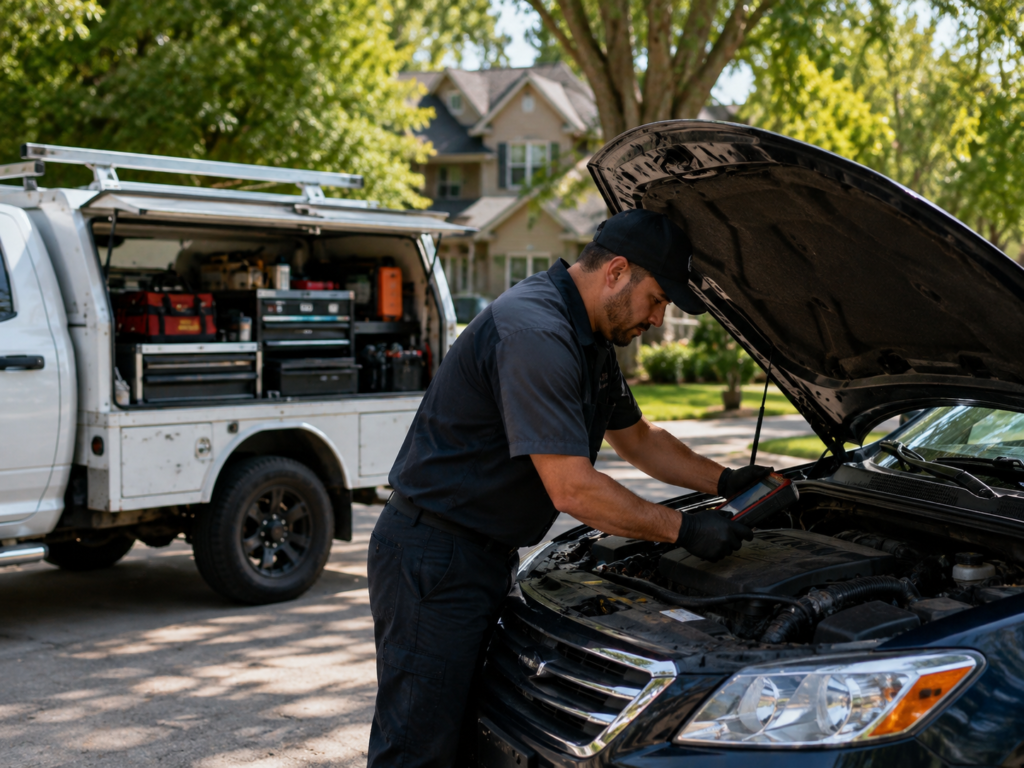
This is where a mobile mechanic has a real advantage over a traditional shop visit. Instead of arranging a tow, taking time off work, or sitting in a waiting room, you can have a certified technician come to your home, your office, or even a parking lot near the Strip, plug in a scanner, and tell you exactly what triggered the light. If you have ever wondered how this compares to a standard repair shop experience, our guide on mobile mechanic vs auto shop what Las Vegas drivers need to know breaks down the differences in convenience, pricing, and turnaround time.
Sometimes the check engine light shows up alongside other warning signs, like rough idling, hesitation when accelerating, or in more serious cases, a car that will not start at all. If you have run into that particular headache recently, our article on the top 10 reasons your car won’t start and how to get back on the road covers many of the underlying causes that can overlap with check engine light issues.
The Bottom Line For Las Vegas Drivers
A check engine light is not something to fear, but it is also not something to shrug off, especially in a climate that is as unforgiving on vehicles as ours is. The cost of a diagnostic visit is small compared to the cost of a part that fails completely because it was pushed past its limit in the summer heat. Catching a problem early almost always means a simpler, cheaper repair, and it means avoiding the stress of a breakdown on a hot afternoon somewhere between Summerlin and Henderson.
If your check engine light just came on, or if it has been on for a while and you have been putting off dealing with it, reach out to our team. We come to you anywhere in the Las Vegas valley, run a full diagnostic on the spot, and give you a straightforward explanation of what is going on and what it will take to fix it. You can reach us directly through our contact us page to schedule a visit at a time that works for you.
Taking care of small issues before the desert heat turns them into big ones is one of the simplest ways to protect both your vehicle and your wallet.